Research topics
How much can we learn about pulsating stars through asteroseismology, astrometry and numerical models? The project will concentrate on the following research topics:
Asteroseismology of pulsating stars
 Ensemble asteroseismology of classical pulsators. Detection, classification and identification of the various low-amplitude modes in RR Lyrae, Cepheid and similar stars. Space-based photometry from the TESS and Kepler space telescopes provide us with thousands of high-quality light curves for this study.
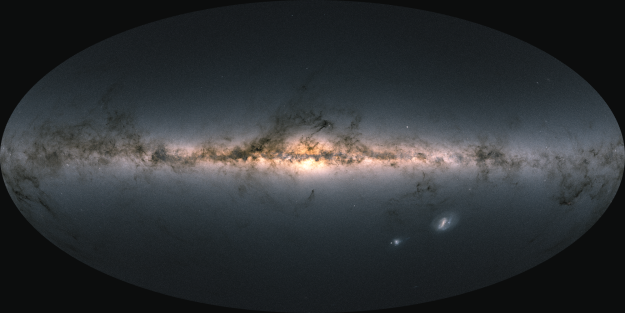
Seismology-astrometry synergies. The revolutionary European Gaia mission complements the photometric data with distance, brightness, and color data for an incredible number of stars. We combine seismic inferences with physical properties from this mission.
Ensemble asteroseismology of classical pulsators. Detection, classification and identification of the various low-amplitude modes in RR Lyrae, Cepheid and similar stars. Space-based photometry from the TESS and Kepler space telescopes provide us with thousands of high-quality light curves for this study.
Seismology-astrometry synergies. The revolutionary European Gaia mission complements the photometric data with distance, brightness, and color data for an incredible number of stars. We combine seismic inferences with physical properties from this mission.
Binary pulsators, pulsators in binaries. Binaries can follow evolutionary paths very different from that of single stars. These can lead to pulsating components resembling normal pulsating variables at unexpected ages, while providing constraints single stars cannot, such as matching component ages, distances and compositions, as well as dynamical masses.
Stellar pulsation and evolution connections
Evolutionary and seismic models. We calculate large model grids with the MESA stellar evolutionary code and with linear stellar oscillation and non-linear stellar pulsation codes. We will use these models for asteroseismic model fitting, to constrain the physical parameters of the stars observed with TESS/Kepler and Gaia.
Origins of anomalous Cepheids. Studies suggest a mixture of two different formation channels: recent star formation and binary star mergers. However, it is not settled how many of these stars exist within our own Galaxy yet, and which of the two evolutionary processes has been more active here.
Strange-mode Cepheids: do they exist? Models predict some stars may pulsate in high-order, low-amplitude trapped modes, but detection in nature has been scant. We will try to find them.
Pulsation models in one and two dimensions
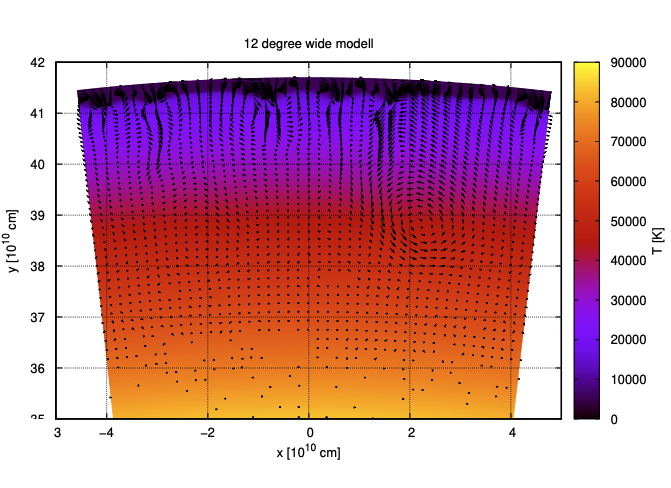 Multi-dimensional models. Run, test and study models capable of calculating two- and three-dimensional wedges of stars, and develop the underlying code.
Convective properties. Convection is only approximated in 1D codes. We search for the best parameters, how they affect stellar pulsation, and how they relate to more physical processes in 2D.
Mode interactions. Multi-mode pulsation modes are sensitive dynamical systems. In 1D models parameter tuning may lead to mode resonances, modulation and other effects. We study whether these models could explain peculiar pulsating stars. We also try to approximate the presence and effects of non-linear modes in the multi-dimensional models.
For students
The team considers mentoring talents and future researchers an important task. We are happy to talk about our work, possible avenues to research and potential research topics to high-school and undergrad students. We also offer topics for TDK/OTDK (University/National Scientific Student Associations’ Conference) projects and encourage BSc/MSc students to apply for the annual research assistant calls at Konkoly Observatory.
Possible research topics / Kutatási témák:
- RR Lyrae csillagok tanulmányozása a Kepler K2 projekt mérései alapján (Studying RR Lyrae stars through the observations of the Kepler space telescope in the K2 mission)
- Változócsillagok fotometriája a SMEI műszerrel - több évnyi űradat a Kepler előttről (Variable star photometry with the SMEI instrument - multi-year space-based data before Kepler)
- A Sagittarius-törpegalaxis RR Lyrae csillagai a K2-vel (RR Lyrae stars in the Sagittarius dwarf galaxy observed with K2)
- A legfényesebb északi RR Lyrae csillagok spektroszkópiai megfigyelései (Spectroscopic observations of the brightest northern RR Lyrae stars)
Software
You can find code and software developed by us at our GitHub page.
For 1D pulsation modeling, we use the Florida-Budapest hydrocode and the Radial Stellar Pulsation module of MESA (RSP, formerly known as the Warsaw hydrocode). You can read more about them here: Turbulent Convective Cepheid Models (Yecko et al., 1998), Double-mode Stellar Pulsations (Kolláth & Buchler, 2001), Formulation of Hydrocodes (Smolec & Moskalik 2016), MESA Instrument Paper V (Paxton et al. 2019). For the multi-dimensional pulsation models we use the SPHERLS code.
Funding Acknowledgement
The SeismoLab project is funded by the Élvonal (Forefront) Research Exellence Program of the Hungarian National Office for Research, Development and Innovation, from 01/09/2021 to 31/08/2026.
Other funding sources related to the project:
- We closely collaborate with the Near-field cosmology Lendület group, led by Róbert Szabó.
- 2021-2022: Csilla Kalup is supported by the ÚNKP-21-2 New National Excellence Program of the Ministry of Human Capacities.
- 2020-2023: Zsófia Bognár is supported by the János Bolyai Research Scholarship of the Hungarian Academy of Sciences.